Posts

Showing posts with the label biography

Production phase for Florence Nightingale

Image
 After a long and restful summer break (the heat made it a rather challenging summer!), I am back to complete the work on the unit about Florence Nightingale and biography writing. You will remember that we already looked at the reception phase, so now it's the turn of the production phase  divided into a guided production phase, where students have the possibility of doing more controlled practice on some aspects of the text, and a free production phase, where they acually write the biography. I must admit that while the structure is very clear for me, I tend to take it for granted that students will be able to write good texts once we have worked on their characteristics. I  have to make a conscious effort to allow enough time for their guided practice, and if I don't, the result is often disappointing. In the unit designed for the Florence Nightingale text, the focus is on three different features of the model text: the need to include factual and specific information,...
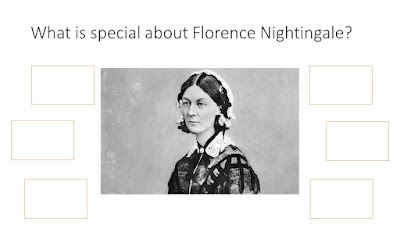
The example of the planning grid continued: Reception Phase for Florence Nightingale

Image
 To llustrate what was said in the last blog entry , I have filled in the Reception Phase in the plannig grid for the unit on Florence Nightingale. As we said in this last entry, the work on the text type biography  starts with some exercises that prepare students to read, understand and enjoy the text. In this case, since the text is somewhat specialized as it talks about nursing, I decided to do some vocabulary work to start with. The other possible source of difficulty our students may have is related to the relevance of Florence Nightingale as one of the few upper-class women in the 19th century to be able to work. Without an awareness of how unusal this situaton was 200 years ago, most students will probably not fully understand the relevance of the person we are dealing with in this unit - hence the next two taks in the teaching sequence. With the scene thus set for the students to be able to understand the text, we ask them to predict its content. This is a reading str...

An example of the first part of the planning grid: Florence Nightingale

Image
As promised, in this blog entry I will share with you the first part of a planning grid for a unit on biographies, that takes the biography of Florence Nightingale as a starting point. You can see that the first three boxes in the planning grid contain basic information about the unit: who it was designed for, what kind of text we are working on and where to find the model text. If we look at the second box, it specifies the type of text we are working on, and then states that this "= General aim of the unit". What this means is that if we are working on a given text type, this is also the text type we are going to ask our students to produce. This working from a model text to a similar production may look a bit mechanic and uninteresting, but it is a crucial part of the Approach : only if my students have developed the necessary understanding of how a given text works and looked at some specific strategies the author uses, can they be expected to produce a text of this kin...